

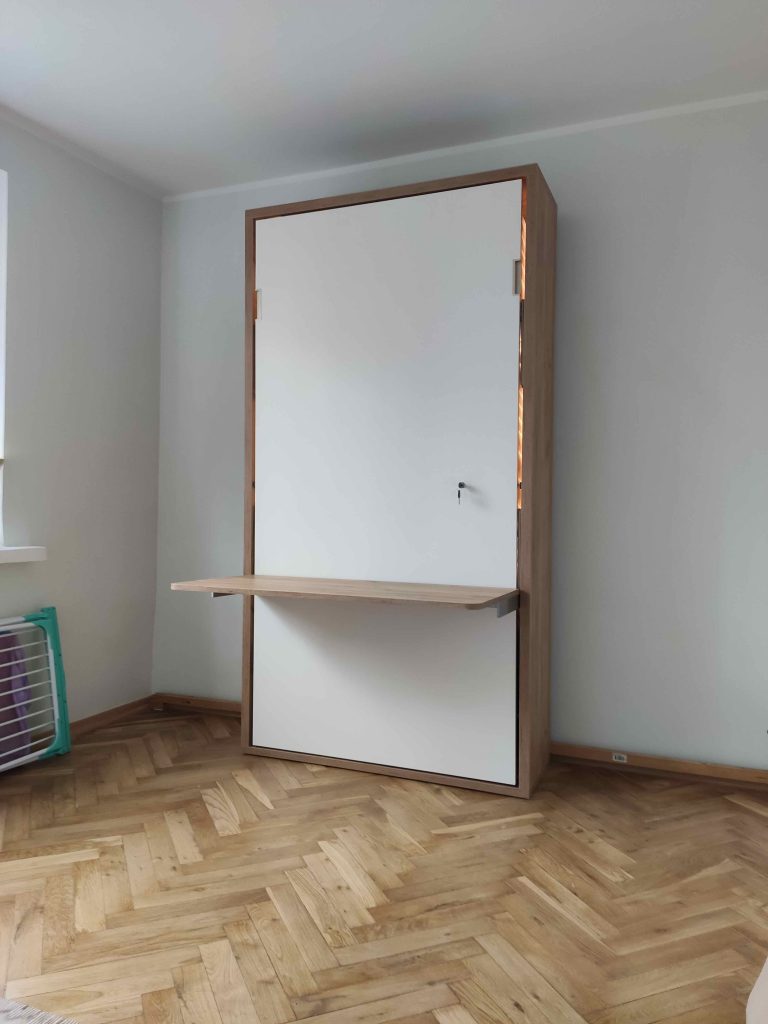

Wall-mounted folding table
A wall-mounted folding table reclaims space where a traditional piece of furniture would otherwise become a barrier. In a studio apartment or a small apartment, every inch of floor space contributes to the comfort of daily life. A fixed table spends most of the day unused, yet it still takes up space. The wall-mounted version eliminates this problem. When folded, the tabletop adheres to a vertical surface and doesn’t interfere with the room’s layout. The space in front of the wall remains free. You can walk freely, add additional seating, or unfold a relaxation area. When you need to work, eat, or meet for coffee, a single movement is enough to lower the tabletop and create a stable usable surface.
When designing wall-mounted folding tables, we consider real-world loads. Laptops, documents, plates, and small kitchen appliances generate pressure that the structure must safely withstand. Therefore, the system relies on solid hinges and a stable base. The mechanism locks the tabletop in a horizontal position, ensuring predictable operation whenever it’s unfolded. This solution is particularly well-suited to micro-apartments, where a single room serves as the living room, dining room, and office. A wall-mounted folding table doesn’t compete with other furniture. It works in concert with them, creating a flexible layout.
A table hidden in the wall
A wall-mounted table is a solution for those who want to maximize the integration of a dining room or office into their interior design. In this configuration, the tabletop, once folded, doesn’t remain a visible, separate element. It blends seamlessly with the wall or furniture system, becoming a natural extension. This ensures the space maintains a clean composition. Visual overload is avoided. The interior appears uncluttered even when it actually serves multiple functions.
This option works particularly well in minimalist arrangements, where uniform fronts and simple divisions dominate. A table hidden in the wall doesn’t disrupt the overall flow of the space. During the day, it can serve as a neutral feature on the wall. In the evening, it transforms into a space for dining, remote work, or coffee meetings. This change is achieved without rearranging furniture or reorganizing the entire room.
In studios and studio apartments, this solution allows for a clear division of functions without creating physical boundaries. The kitchenette can remain open to the living room. The absence of a traditional dining area doesn’t mean sacrificing the comfort of eating at the table. Simply activate the integrated system. The space responds to the needs of the moment.
The design aspect is crucial. A wall-mounted table requires solid anchoring to the floor and proper force distribution. The wall type, mounting method, and installation depth all impact stability. The tabletop should be mounted at a height that ensures an ergonomic seating position. Too low a mounting position will reduce comfort. Too high a mounting position will make everyday use difficult. In a well-designed system, the structure does not generate play or vibration during use. The mechanism must operate predictably. It is precisely this precision of workmanship that determines whether the table will become a real support in a small apartment or merely an interesting addition.
A table that extends from the wall
A table that extends from the wall addresses the need for flexible, usable space without permanently occupying space. Unlike traditional tables with additional inserts, it doesn’t require storing separate components. The entire structure remains integrated with the wall. Users don’t need to search for additional components or rearrange the surroundings.
This solution is particularly practical in narrow spaces, where every centimeter of space impacts comfort. A standard table could obstruct communication between the kitchen and the lounge area. The extendable version activates only when needed. After use, it returns to its original position, restoring freedom of movement.
A table extending from the wall can serve as a dining area for two, a compact desk, or an additional worktop in a kitchenette. In investment apartments, it enhances the attractiveness of the premises without the need for permanent, massive furniture. Tenants gain the comfort of working and eating at the table, while owners don’t lose space that could be used for other functions.
The design of such a system requires the appropriate selection of tabletop depth and width. The surface area must be sufficient to ensure practical use. At the same time, it should not restrict space when folded. The structure should be able to withstand the loads of daily use and maintain stability even after repeated deployment.
The mechanism must operate smoothly. Extending it shouldn’t require force or generate noise. A well-designed table that extends from the wall becomes a natural part of the daily routine. In the morning, it serves as a workstation. At noon, it serves as a dining area. In the evening, it disappears, leaving the space open and uncluttered. This adaptability makes the solution a perfect fit for a multifunctional interior.
Folding tabletop
A folding tabletop is a versatile built-in element that can serve many functions. Depending on its location, it can become a dining table, a desk, an additional work surface in the kitchen, or a helpful station in a children’s room. In small apartments, this module allows for flexible response to changing needs.
In the morning, it can serve as a remote workspace. In the afternoon, it can serve as a meal preparation area. In the evening, it disappears from view, leaving the interior open and uncluttered. Ergonomic installation is crucial. The height should correspond to the intended use of the countertop. In a kitchen, the required height differs from that in an office workspace. The width and depth should be adapted to the actual usage scenario to avoid functional limitations.
A folding tabletop can be part of a larger furniture system. When combined with a wall bed or wall unit, it creates an integrated structure that allows a single wall to serve multiple functions simultaneously.
A table hidden in a cabinet
A table hidden within a cabinet is a discreet and visually uncluttered solution. Once folded, the design is identical to a standard furniture front. The countertop is concealed within the cabinet body, maintaining a minimalistic character. This solution works well in modern pocket kitchens and living rooms integrated with kitchenettes.
When the table isn’t needed, the structure remains uniform. Extending or lowering the tabletop creates a stable surface for dining or working. In small apartments, a table that can be hidden within a cabinet eliminates the need for additional furniture in the center of the room. Circulation remains unobstructed. The interior doesn’t feel cluttered.
The design requires precise planning of the mechanism and the cabinet’s internal space. The structure must be adequately reinforced to withstand the loads without deforming the front.
A table that pulls out from the wall
A table that extends from the wall allows for a quick increase in usable space without interfering with the existing interior layout. In this configuration, the tabletop moves on guides, extending from the built-in unit and creating additional workspace. This is an ideal solution for narrow kitchenettes and studio apartments. The extendable table can serve as a temporary dining area or workstation. When not in use, it returns to the wall, leaving the space free.
The guide mechanism should ensure stability and even support for the entire surface. The extension must be smooth. The structure must not exhibit excessive play or deflection. Combined with other built-in elements, such as a wall unit or a retractable bed, a wall-mounted table creates a comprehensive arrangement system. A single wall serves storage, relaxation, and work. This approach allows a small space to function as a well-designed multifunctional space.